
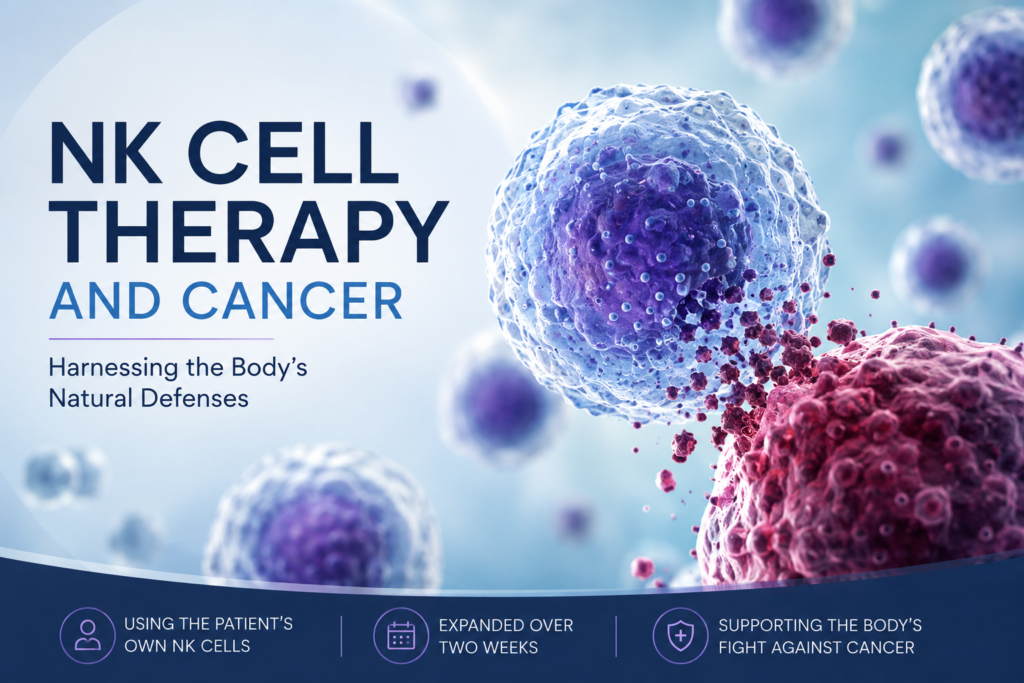
Cancer treatment has advanced dramatically in recent years, and one of the most exciting areas of research is immunotherapy—approaches designed to help the immune system recognize and attack cancer.
Among the immune cells being studied are Natural Killer cells, or NK cells. Unlike some immune cells that require prior exposure to a specific target, NK cells are part of the body’s innate immune system and have a natural ability to recognize and destroy certain abnormal, infected, and cancerous cells.
What Is NK Cell Therapy?
NK cell therapy is an investigational form of cellular immunotherapy that seeks to increase the number or activity of NK cells available to fight cancer.
Our approach uses autologous NK cells, meaning the process begins with the patient’s own immune cells rather than NK cells obtained from a donor.
The process generally follows three stages:
1. Collection
Blood is collected from the patient so their NK cells can be isolated.
2. Expansion and Activation
The patient’s NK cells are then processed outside the body and expanded over approximately two weeks. The goal is to substantially increase the population of NK cells available for treatment and enhance their activity under controlled laboratory conditions.
This concept of expanding a patient’s own NK cells outside the body has been evaluated in human clinical studies. Published trials have demonstrated that autologous NK cells can be expanded substantially before being returned to the patient.
3. Reinfusion
Following expansion and appropriate testing, the NK cells are administered back to the patient. The objective is to provide the immune system with a larger population of activated NK cells capable of recognizing and attacking susceptible cancer cells.
Why Are NK Cells Interesting in Cancer Treatment?
Cancer can be difficult for the immune system to control because tumor cells can develop mechanisms that allow them to evade immune detection.
NK cells are particularly interesting because they can identify abnormal cells and release molecules that can cause those cells to die. Researchers are studying ways to increase this natural cancer-fighting ability through activation, expansion, genetic engineering, and combinations with other cancer therapies.
Rather than directly attacking a tumor through surgery, radiation, or chemotherapy, NK cell therapy attempts to strengthen one component of the patient’s own immune response against cancer.
What Does the Research Show?
NK cell therapy remains an evolving field, but early clinical research has produced encouraging signals.
For example, a Phase I study evaluated expanded, activated autologous NK cells combined with trastuzumab in patients with HER2-positive cancers. Researchers achieved a median 340-fold laboratory expansion of NK cells. The combination was well tolerated in the study, and among 19 patients receiving the specified NK-cell dose, six experienced stable disease lasting at least six months. One patient experienced a partial response.
Another early Phase I/II study evaluated expanded autologous NK cells in patients with advanced solid tumors. Investigators reported that the treatment was generally well tolerated in the small study and observed preliminary evidence of antitumor activity, while emphasizing the need for additional research.
A broader systematic review and meta-analysis published in 2024 examined 31 trials involving approximately 600 patients with solid tumors. The authors concluded that NK-cell therapies show promise, while also emphasizing that further research is necessary to determine how these therapies can best be incorporated into cancer treatment.
Could NK Therapy Complement Traditional Cancer Treatment?
Potentially—and this is an important area of ongoing research.
NK therapy is being investigated both independently and in combination with established cancer treatments, including monoclonal antibodies and other forms of immunotherapy. For example, researchers have studied expanded NK cells alongside trastuzumab because NK cells can participate in antibody-dependent cellular cytotoxicity, one mechanism through which antibody therapies can help target cancer cells.
The appropriate strategy depends heavily on the patient’s cancer type, stage, previous treatments, current disease status, and overall health.
For that reason, NK therapy should not be presented as a replacement for chemotherapy, radiation, surgery, targeted therapy, or other oncologist-recommended treatment.
A Personalized Immune-Based Approach
One of the distinguishing features of our NK program is that the cells originate from the patient.
The patient’s blood is collected, their NK cells are isolated and expanded outside the body for approximately two weeks, and the expanded cells are then returned to the patient.
The concept is straightforward:
Start with the patient’s own natural killer cells. Expand their numbers. Return those cells to the patient with the goal of strengthening the body’s existing immune response against cancer.
NK-cell therapy is still being actively investigated, and results can vary significantly based on cancer type and individual circumstances. It should not be described as a cure or as proven to prevent cancer recurrence.
Patients considering NK-cell therapy should review their individual case with their oncologist and the medical team overseeing the cellular therapy to understand potential benefits, risks, alternatives, and how the treatment could fit alongside their existing cancer care.
This information is educational and is not intended to diagnose, treat, cure, or prevent cancer. NK-cell therapies are investigational for many cancer indications, and regulatory status varies by product, protocol, and country.